Formula car aerodynamics ── a fundamental difference from GT cars
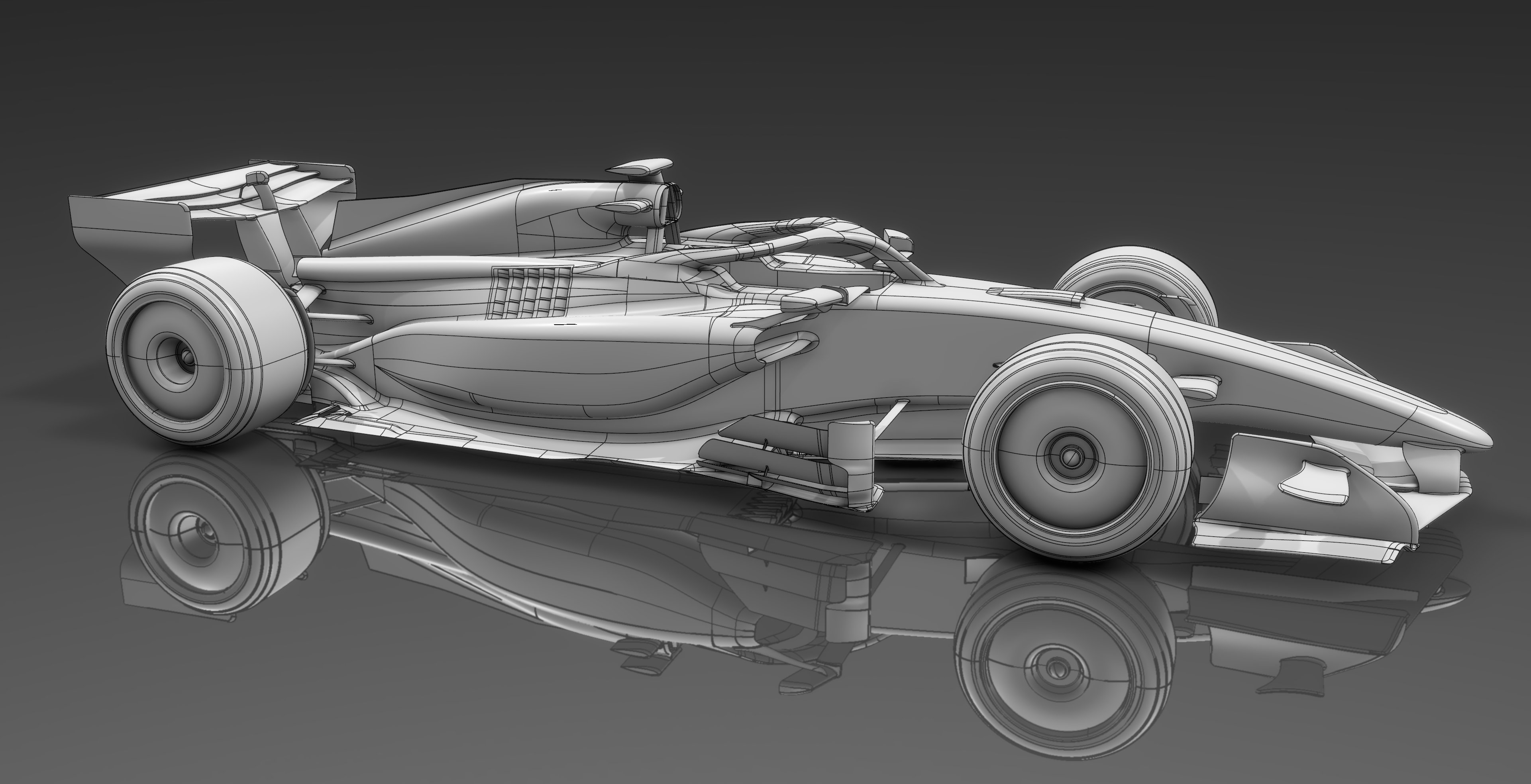
In the aerodynamic development of GT cars and road cars, the basic strategy is to use bodywork that covers the whole car to smooth the airflow, gaining downforce while reducing drag. The aerodynamic principles of a formula car, however, differ greatly from this.
The defining feature of a formula car is that its tires are exposed. A rotating exposed tire is both a huge source of drag and the origin of a tire wake (turbulence) behind it that seriously affects downstream aerodynamic devices. How to deal with this tire wake is the biggest theme in formula-car aerodynamic development.
The downforce sources of a formula car can be broadly divided into three: the front wing, the underfloor (including the diffuser) and the rear wing. Each has different physical principles and constraints, and together they form the overall aerodynamic balance.
Front wing ── the most efficient aerodynamic device
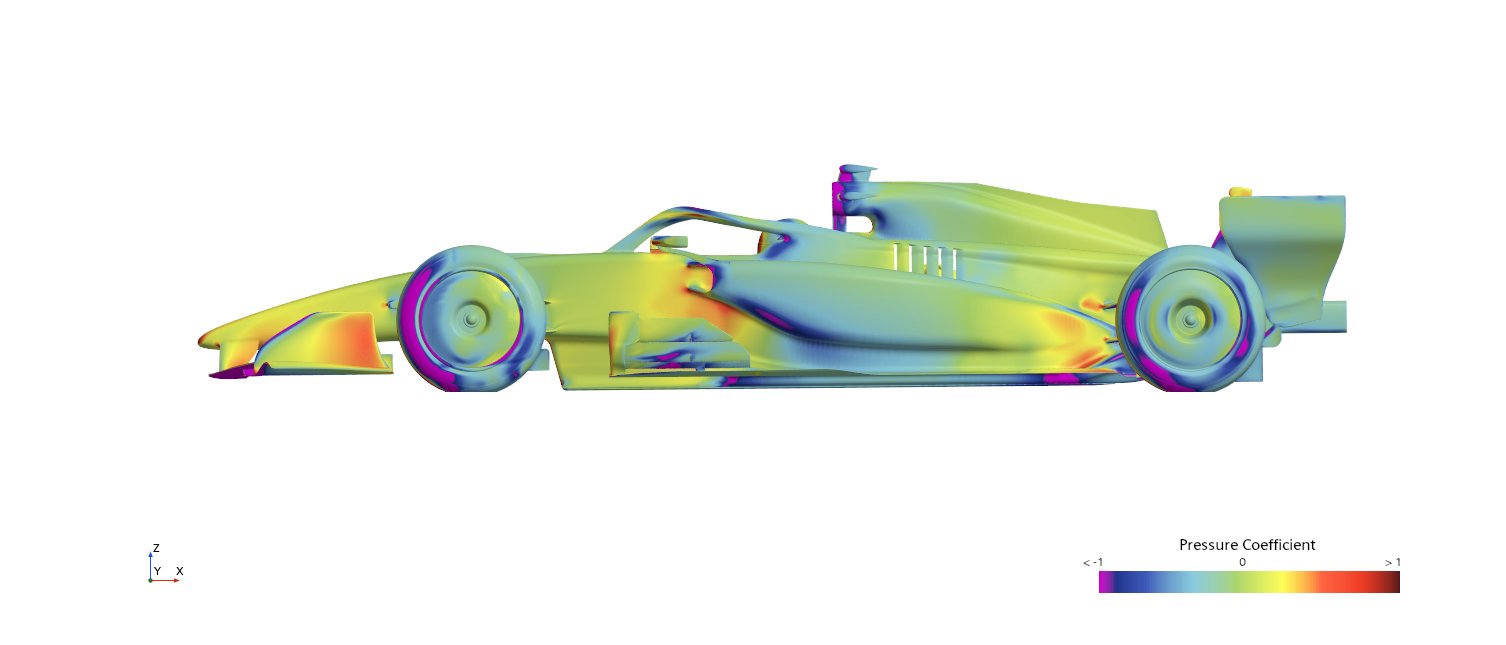
The front wing is the most efficient downforce-generating device on a formula car. There are two main reasons.
First, the front wing is mounted very close to the ground. As a wing approaches the ground, the passage between the wing and the ground narrows, the flow speeds up and the pressure drops further — the so-called ground effect. Thanks to this, the same airfoil produces far more downforce than it would in free air.
Second, recent regulations permit a multi-element configuration. By combining multiple wing elements, the flow can be kept attached even at high camber that would separate on a single wing, making it possible to generate very large downforce. As a result, the front wing carries almost all of the front downforce.
Looking at the side Cp distribution, deep purple (strong negative pressure) appears around the front wing, showing that the flow accelerates greatly on the front wing’s suction side.
Underfloor ── ground effect that sucks the whole car down
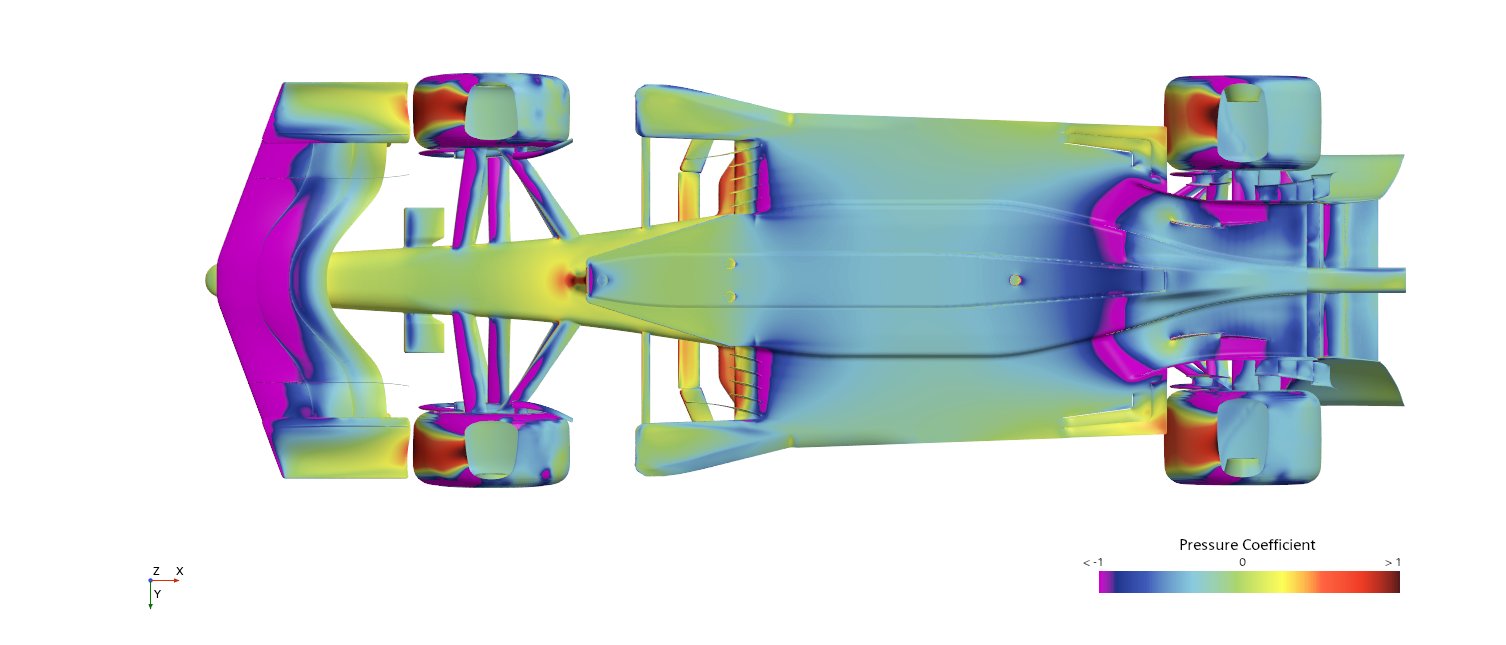
The underfloor refers to the broad region from the car’s bottom surface to the diffuser. The air flowing between the ground and the car’s underside is accelerated by the Venturi effect, generating large negative pressure across the whole underside and sucking the entire car toward the ground.
Looking at the underside Cp distribution, most of the underfloor is covered in blue to purple. This means pressure lower than atmospheric — that is, negative pressure — acts on the underside. While the car’s upper surface is near atmospheric pressure, this much negative pressure spread across the underside means the pressure difference between top and bottom lets the atmosphere press the car down toward the ground.
The underfloor has a structural challenge, however. Because the floor inlet is located behind the front tires, it ingests the tire wake (turbulence) produced by the front tires. The tire wake is a low-energy flow — slow and having lost its kinetic energy — and once it enters the floor, the flow speed needed for the Venturi effect cannot be maintained, greatly reducing downforce-generation efficiency.
Managing the tire wake: How to exclude the wake generated by the front tires from the floor inlet and introduce clean air into the underfloor — this is the most important development point in formula-car aerodynamics. It is no exaggeration to say that aerodynamic devices such as bargeboards, turning vanes and floor edges all exist to manage this tire wake.
Rear wing ── the trade-off between efficiency and drag
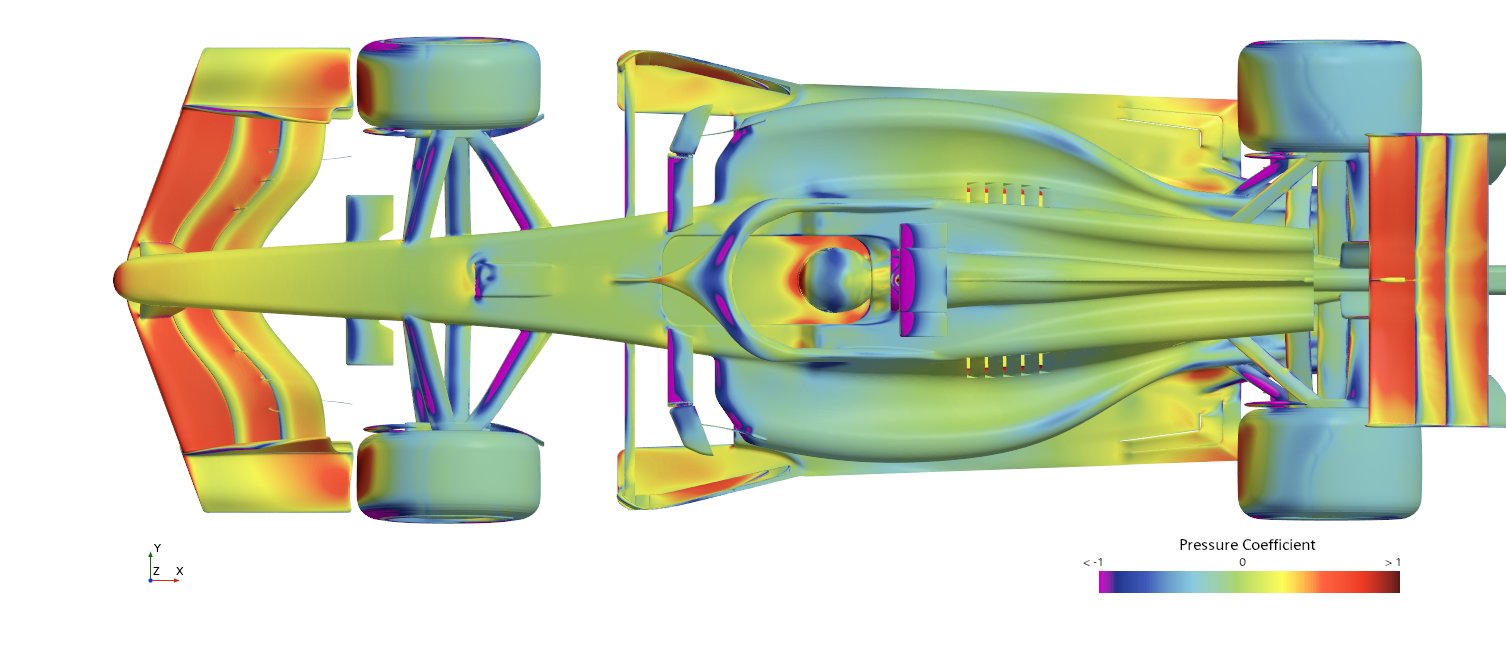
Of the three downforce sources, the rear wing is actually the least efficient device. The reasons lie in its shape and mounting conditions.
Because the rear wing is mounted high, away from the ground, it cannot benefit from ground effect the way the front wing and underfloor do. Moreover, its span is limited by regulation while its chord is long — a so-called short-span, long-chord planform. This shape has a low aspect ratio (span/chord), so induced drag from wingtip vortices is large, making its drag penalty markedly greater than that of the other aerodynamic devices.
For this reason, top speed on the straights is directly tied to the rear wing’s aerodynamic efficiency. In F1 and other formula cars, the rear-wing specification is changed to match circuit characteristics — a high-speed course or a low-speed technical one. A low-downforce spec is chosen for high-speed circuits like Monza and a high-downforce spec for low-speed courses like Monaco, with the front-to-rear aerodynamic balance typically adjusted via the front-wing flap angle.
For a more detailed explanation of rear-wing efficiency and design, please also see our earlier article “What makes a high-performance GT wing?”
Contribution of each component ── the breakdown in numbers
In CFD analysis, the aerodynamic forces acting on each part of the car can be tallied individually. The pie charts below show the share each component takes of the total, for downforce (Cz) and drag (Cx) respectively.
Note the sign of Cz: the aerodynamic coefficient Cz is downforce when negative (a downward force) and lift when positive (an upward force that cancels downforce). In the charts below, components that contribute to downforce (Cz < 0) are shown as pie charts, while components that produce lift (mirrors, rear tires, etc., Cz > 0) are noted as annotations.
Looking at the downforce breakdown, the front wing accounts for about 42% of the total, making it the single largest DF source. It is followed by the underfloor (including the diffuser) at about 28% and the rear wing at about 19%. These three make up roughly 89% of the total, confirming numerically that formula-car aerodynamics is built around these three devices.
On the drag side, the four tires account for about 55% of the total. It is obvious at a glance how large a drag source exposed tires are. The drag of the front and rear wings is around 10% each; the reality of a formula car is that the tires — a “non-aerodynamic component” — dominate more than half of the drag, more than the devices that generate downforce.
Summary ── the constraint of open wheels
The biggest reason formula-car aerodynamics is special comes down to the exposed tires. The front wing achieves high efficiency through ground effect and a multi-element layout, but the exposed tire immediately behind it produces a huge wake. The underfloor is a powerful device that sucks the whole car down, yet it is constantly exposed to the low-energy flow of the tire wake. The rear wing, though disadvantaged in efficiency, plays an indispensable role as the adjustment valve for front-to-rear balance.
On GT cars and road cars, the bodywork conceals the tires, so the tire-wake problem is not as serious as on a formula car. This seemingly simple difference — “exposed tires” — fundamentally changes the very philosophy of aerodynamic design.
SERIES — Downforce of the modern formula car
① Sources of downforce (this article)
② Dealing with tire wake