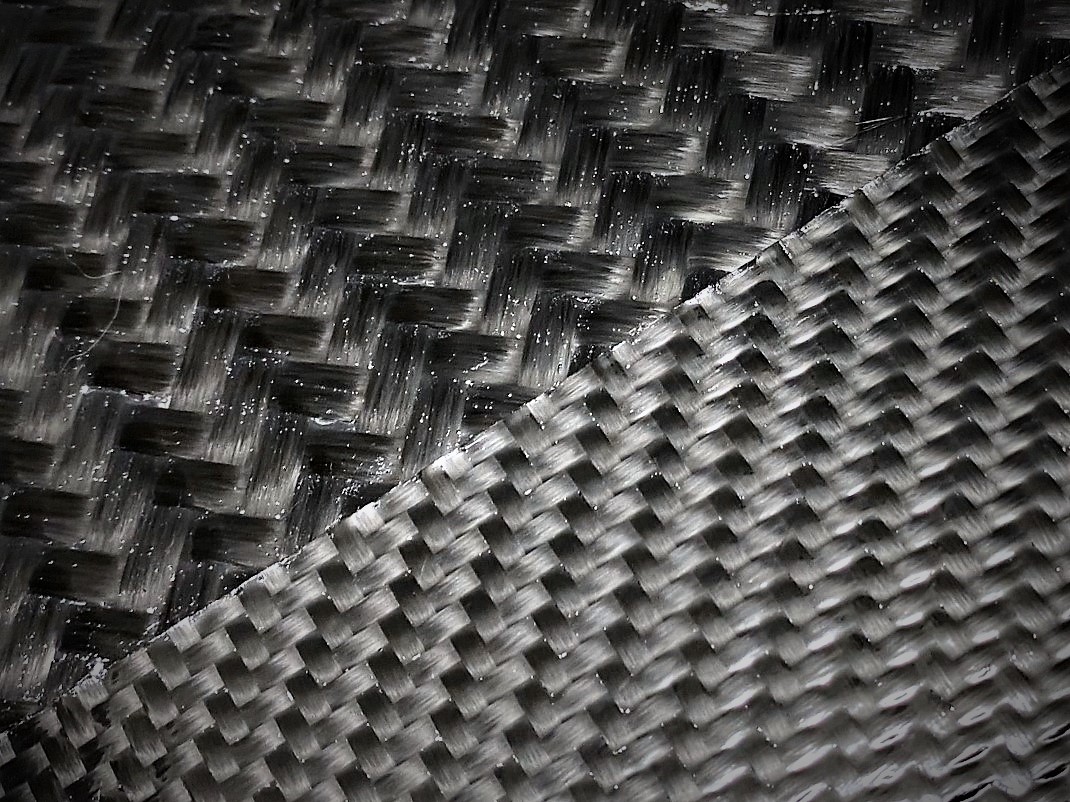
What is the “weave” of carbon fiber?
The carbon cloth used in CFRP (Carbon Fiber Reinforced Plastics) is a sheet material woven with “tows” — bundles of thousands of ultra-fine carbon filaments — as the warp and weft. The pattern of this weave greatly changes the appearance, strength and ease of forming.
The two representative weaves are “plain” and “twill.” Each has clear advantages and disadvantages, and it is important to use them appropriately according to the application and design intent.
Comparing the structure of the weaves
Plain weave
PLAIN WEAVE
Twill weave
TWILL WEAVE (2/2)
Structure of plain weave
Plain weave is the simplest weave structure, in which warp and weft cross alternately one thread at a time. Characterized by a uniform checkerboard pattern, it has a fine weave and a good strength balance in both directions.
Structure of twill weave
In twill, the warp crosses after passing over two or more weft threads. In common carbon cloth, “2/2 twill” (two over, two under) is widely used, producing the distinctive “herringbone” pattern in which the weave runs diagonally.
Performance comparison
| Item | Plain weave | Twill weave |
|---|---|---|
| Appearance | Uniform checker pattern. Neat, functional impression | Diagonally flowing weave. Premium aesthetic |
| Strength balance | Even strength in warp/weft directions. Stable properties | Slightly anisotropic, but ample strength in practice |
| Formability | Stiff weave; somewhat hard to follow complex curves | Supple cloth; conforms easily to 3D curves |
| Cloth thickness | Many crossings; tends to be slightly thick | Few crossings; finishes thin easily |
| Typical use | Structural members, plates, flat parts | Exterior/aesthetic parts, forming complex shapes |
Selection criteria in CFRP design
When aesthetics are required → twill
Twill is often chosen for “visible” parts such as exterior panels, hoods and roofs. The diagonally running weave changes its expression with the reflection of light, creating the premium look characteristic of carbon. In the automotive and motorsport world, twill carbon has become synonymous with “premium.”
When structural strength takes priority → plain
Plain weave suits internal structures, hidden reinforcements and flat plates. Its even strength balance in the warp/weft directions makes it well suited to structural members with complex load directions. Its dense weave also has the advantage of making resin-impregnation control easier.
When choosing by formability → twill has the edge
Twill is superior at conforming to 3D curves. With fewer crossing points, the cloth is supple, so in forming fenders and aero parts with double curves (compound surfaces), twill is less prone to wrinkling and offers better workability.
In SYNSETECH’s CFRP design, we perform optimal layup design combining twill, plain and even UD (unidirectional) material according to the part’s application, load conditions and appearance requirements. Starting from the aerodynamic loads derived by CFD analysis, our approach of selecting fiber orientation and weave lets us design CFRP parts that unite function and beauty.
Summary
Neither twill nor plain is inherently “superior”; they are used appropriately according to design intent and operating environment. Choosing not only by visual preference but also by considering formability, strength characteristics and compatibility with the layup is the first step toward good CFRP design.
← Back to blog list