First, the basics: why does a wing generate lift?
To understand how a Gurney flap works, we first need to know why an airfoil generates lift. The common explanation — “the upper surface is longer, so the flow speeds up and pressure drops” — captures only one side of what is actually happening. Essentially, the concept of “circulation” is the key.
Step 1 — Symmetric airfoil and circulation
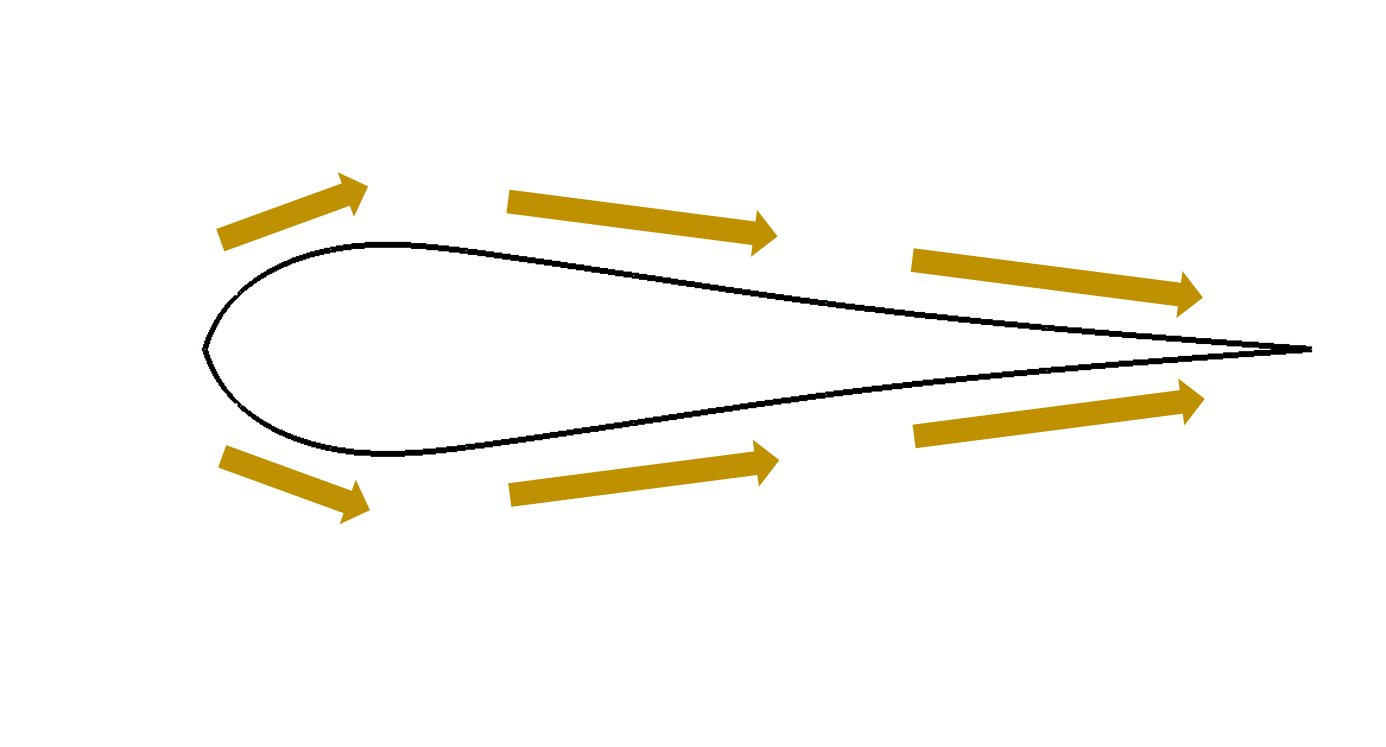
A teardrop-shaped symmetric airfoil produces zero lift at 0° angle of attack because its upper and lower surfaces are symmetric. But once an angle of attack is applied, circulation develops around the wing in order to satisfy the condition that the flow leaves the trailing edge smoothly (the Kutta condition).
This circulation increases the flow speed over the upper surface and decreases it under the lower surface, creating low pressure on top and high pressure below. That is the true nature of lift. What matters is that the strength of the circulation directly determines the magnitude of the lift.
Step 2 — Adding camber
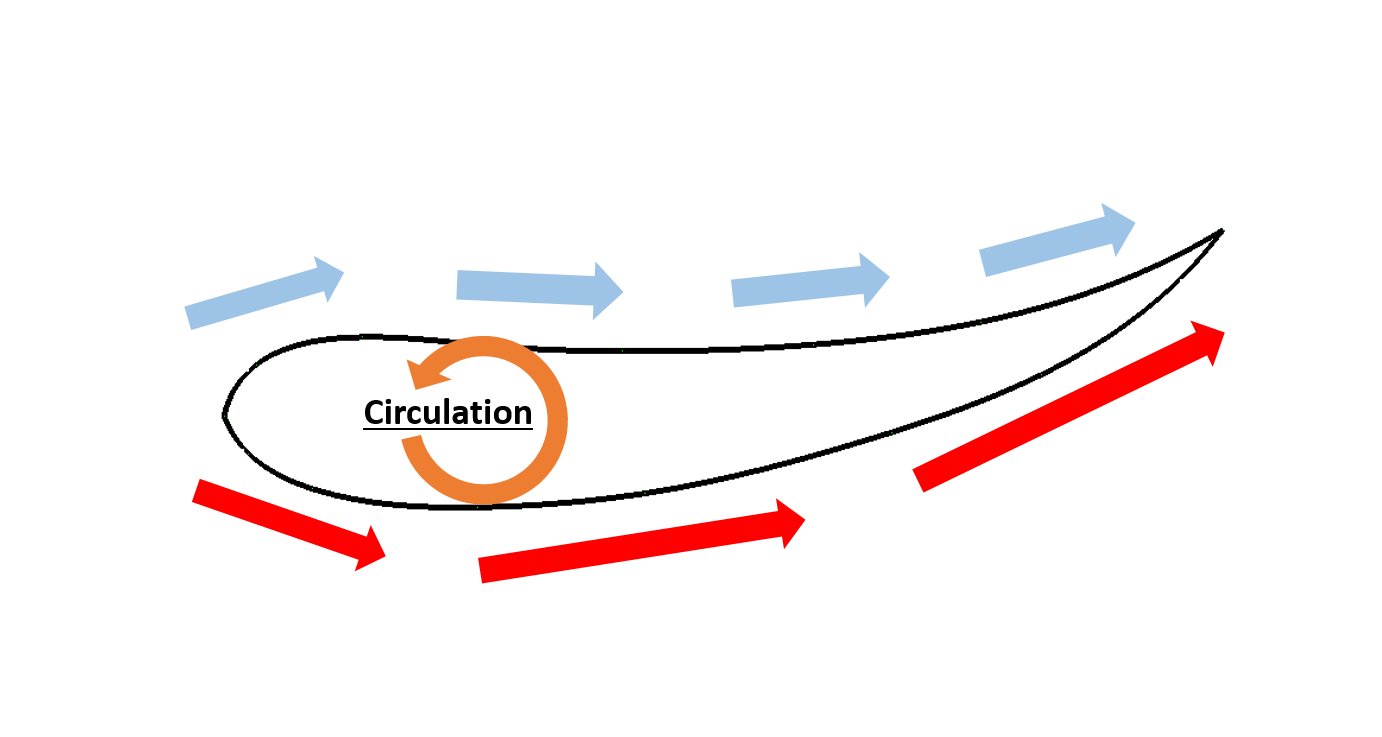
When camber is added to a symmetric airfoil, circulation develops to satisfy the Kutta condition even at 0° angle of attack. In other words, camber can be thought of as a device that “increases circulation”.
On a race car’s rear wing, the airfoil is used upside down, so the upper surface (body side) becomes the pressure side and the lower surface (road side) becomes the suction side. The greater the camber, the more downforce — but changing it requires modifying the airfoil itself, which limits fine-tuning at the track.
The effect of the Gurney flap
Step 3 — Raising a small plate at the trailing edge
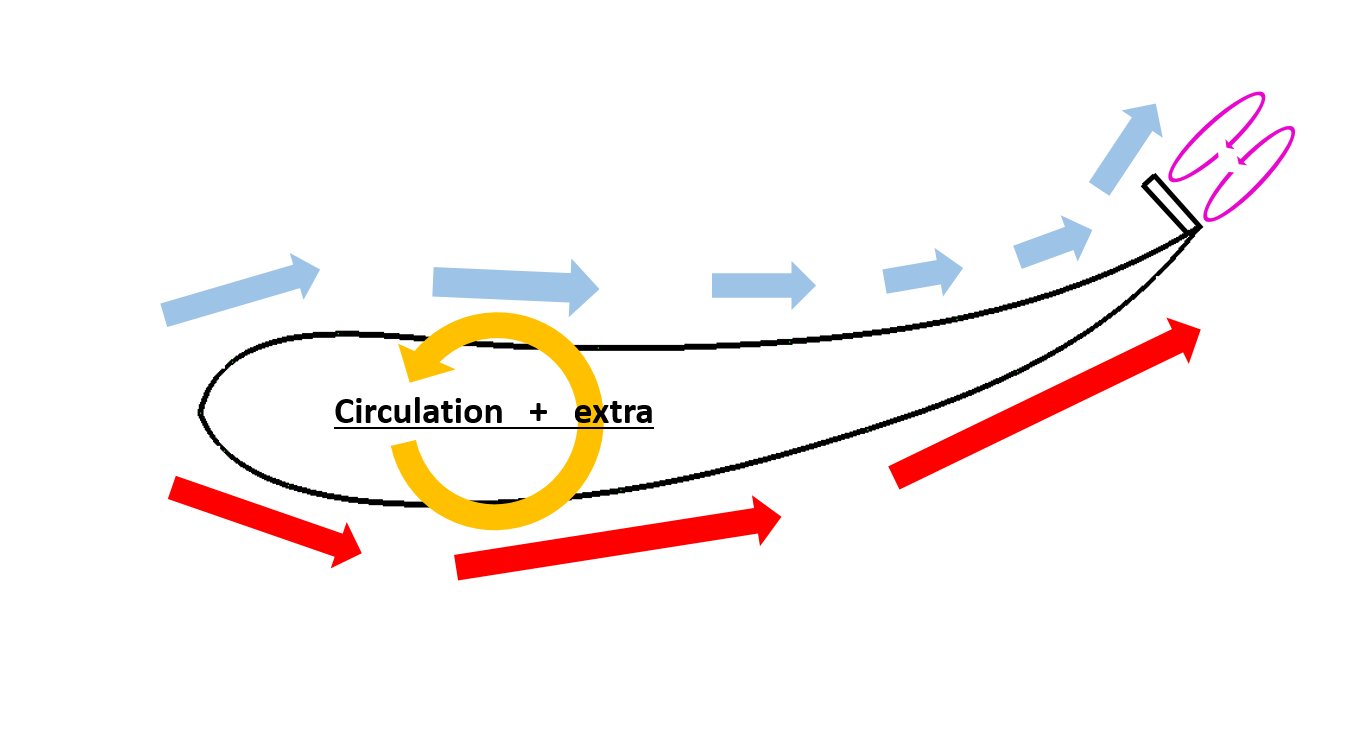
This is where the Gurney flap comes in. You simply mount a small plate — about 1–5% of the chord — perpendicular to the pressure side at the trailing edge. That change alone dramatically increases downforce.
Why? The mechanism is as follows:
How the Gurney flap works:
① It dams the flow at the trailing edge of the pressure side (upper surface), raising the pressure there further
② On the suction side (lower surface), a trailing-edge vortex forms and the turning of the flow strengthens
③ As a result, circulation increases without changing the airfoil’s camber
④ Increased circulation = increased downforce
In other words, the Gurney flap is a bolt-on device that achieves “the same effect as increasing camber without changing the airfoil.” Because it alters the flow condition at the trailing edge and thereby affects the entire circulation, this very small plate produces a large aerodynamic effect.
Effect on the lift coefficient
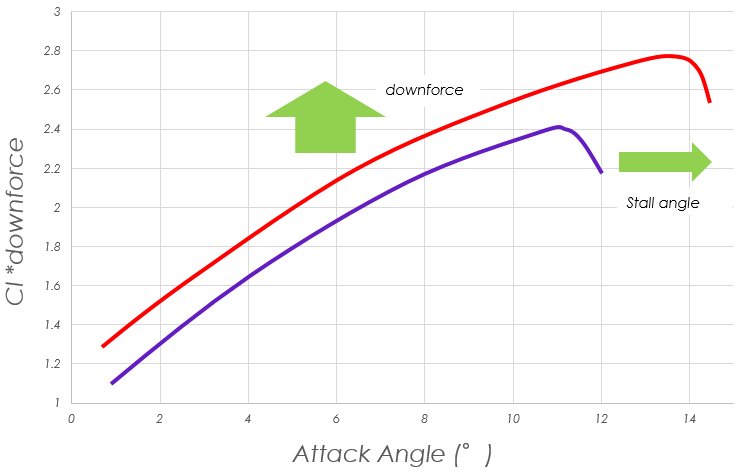
The graph above shows how the lift coefficient (Cl) changes with and without a Gurney flap. The red line (with flap) is shifted upward relative to the purple line (without) across the entire range.
There are two points worth noting:
① Downforce increase across all angles of attack
The Gurney flap’s effect is not limited to a specific angle of attack; it consistently raises Cl from low to high angles. This is the same trend as increasing camber, and the increase in circulation can be confirmed on the graph.
② Behavior near the stall angle
While the purple line (no Gurney flap) reaches stall at around 11°, the red line maintains its Cl even in the same region. However, because the Gurney flap also increases drag, the balance with aerodynamic efficiency (L/D ratio) must be assessed at the design stage.
Use at the track
The Gurney flap’s greatest advantage is that it lets you adjust the aerodynamics on the spot at the track. Modifying the airfoil itself requires manufacturing new parts, but a Gurney flap is just a strip of aluminum or carbon a few to a dozen-odd millimeters tall, attached to the trailing edge. Looking at free-practice results and changing its height before qualifying is an everyday operation.
There is a caveat, however. While the Gurney flap increases circulation, it also forms a vortex at the trailing edge and therefore increases drag as well. Once its height exceeds about 2% of the chord, the drag increase becomes pronounced, so an overly tall Gurney flap sacrifices top speed. The optimum of this trade-off is determined according to circuit characteristics and the car’s downforce requirements.
In SYNSETECH’s contract CFD analysis, we quantitatively evaluate how the height, angle and shape of a Gurney flap affect downforce and drag using numerical analysis with CFD tools. By searching for the optimal setting in a virtual wind tunnel before physical testing, you can make effective use of limited track time.
Summary
In a single sentence, the principle of the Gurney flap is: “a device that increases circulation without changing the airfoil, by damming the pressure-side flow at the trailing edge.”
Understanding it as a progression — circulation on a symmetric airfoil → increased circulation from camber → further increased circulation from a Gurney flap — reveals why this small plate has such a large effect. For a race engineer, the Gurney flap is one of the most cost-effective aerodynamic tuning tools.
← Back to blog list