Is carbon fiber “ten times stronger than steel”?
A phrase you often see in marketing for carbon (CFRP = Carbon Fiber Reinforced Plastic) is “ten times the strength of steel.” It is true that the tensile strength of carbon fiber alone reaches 3,000–7,000 MPa, far exceeding steel (around 400–500 MPa) in raw numbers.
But this comparison has a big pitfall. In a real product, carbon fiber is never used at 100%. It is always used as a “composite material” combined with a matrix resin. The strength of resin-impregnated CFRP is significantly lower than the fiber-only value. Furthermore, the strength in the direction perpendicular to the fibers is markedly weaker.
Key point: CFRP performance is determined by the product of four factors — “fiber type,” “fiber orientation (direction),” “matrix resin” and “molding process.” The strength of a part cannot be described by the spec of the carbon fiber alone.
In other words, in CFRP design not only the fiber but also which resin is used, in which direction the fibers are placed and how it is molded are extremely important. The starting material used for this is “prepreg.”
What is prepreg?
Prepreg (pre-impregnated material) is a sheet-form intermediate material in which reinforcing fibers such as carbon or aramid fiber are pre-impregnated with a thermosetting resin (mainly epoxy). It becomes a final product by being cut to the required shape, laid up in a mold and cured under heat and pressure.
In the motorsport world, molding prepreg in an autoclave (pressurized heating oven) is the mainstream method. By applying high pressure (up to about 7 atmospheres) and high temperature (120–180 °C) simultaneously, air bubbles are eliminated as far as possible and a high-quality laminate with an increased fiber volume fraction (Vf) is obtained. Almost all F1 and Super GT monocoques and aero parts are manufactured this way.
There are several types of prepreg, used appropriately according to the application and required properties. The representative types are introduced below.
Types of prepreg
1. Woven cloth ── twill weave
One of the most popular carbon prepregs. In a cloth-like form woven with warp and weft alternately, fibers are placed in both the warp and weft directions, giving a quasi-isotropic strength balance.
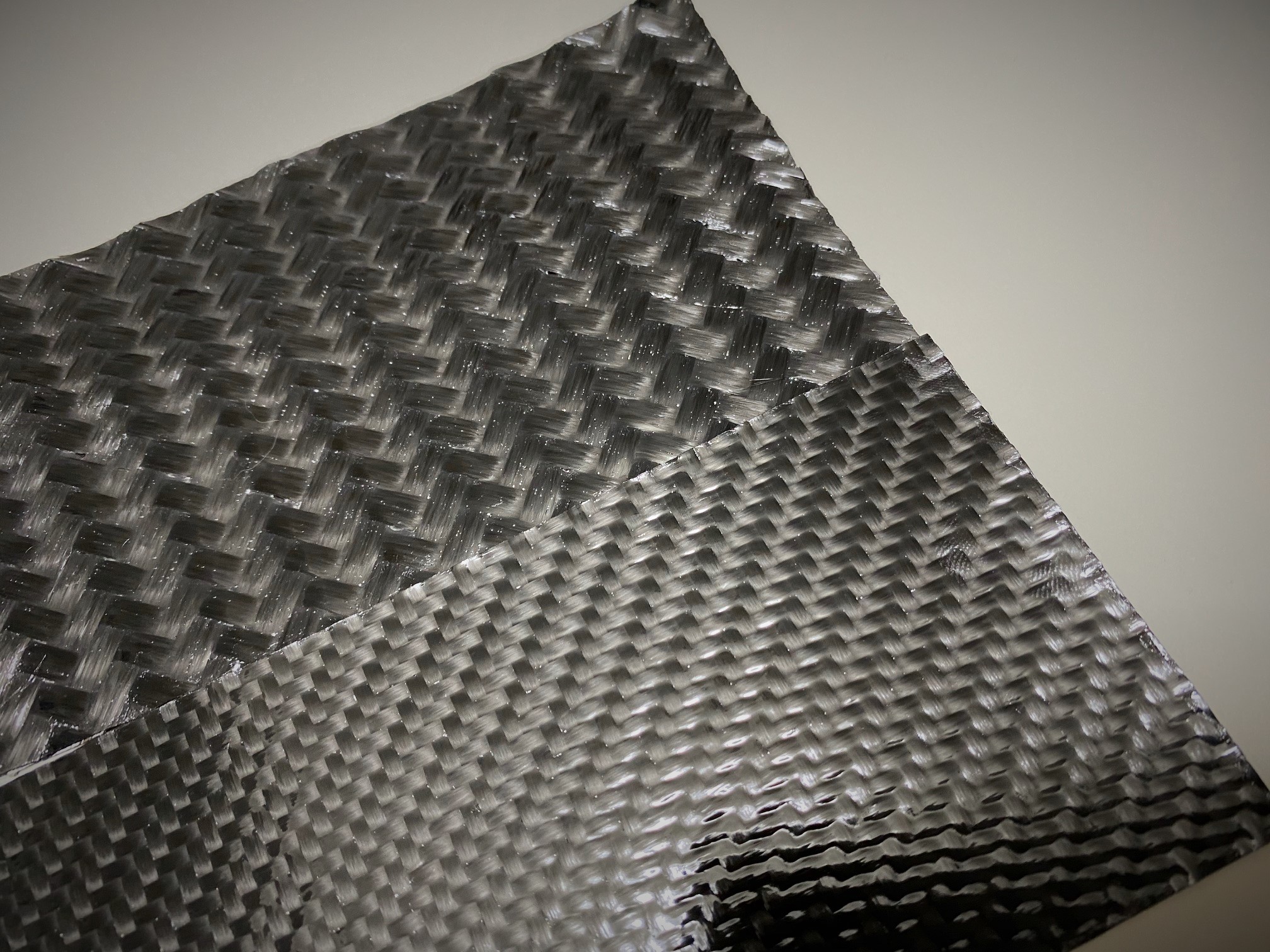
Twill weave is characterized by fibers drawing a diagonal pattern. Because it has fewer fiber crossing points than plain weave, it has excellent drapability (conformity to the mold) and the advantage of fitting complex 3D shapes easily. It is widely used for parts with many curved surfaces, such as hoods and cowls.
In the photo, the top is 12K (a tow bundling 12,000 filaments) and the bottom is 3K (3,000) twill. The thicker 12K tow has a coarse weave and a large areal weight (fiber weight per unit area), so a thick laminate can be built up with fewer plies, offering good work efficiency. The 3K, on the other hand, has a fine weave and a delicate look, suiting thin parts and cosmetic surfaces. The choice of tow thickness is decided by the balance of thickness, appearance and cost required for the part.
The general weakness of woven cloth is that “crimp” — the up-and-down waviness of the fibers — occurs. Because the fibers are not straight, tensile strength is lower than UD (described later). However, it has a large advantage in formability and ease of handling.
2. Spread tow fabric
Spread tow fabric is made by spreading ordinary tows (fiber bundles) thin and then weaving them into cloth. Because the fiber bundles are thin and flat, crimp (fiber waviness) is greatly reduced compared with conventional woven fabric, improving strength and stiffness.
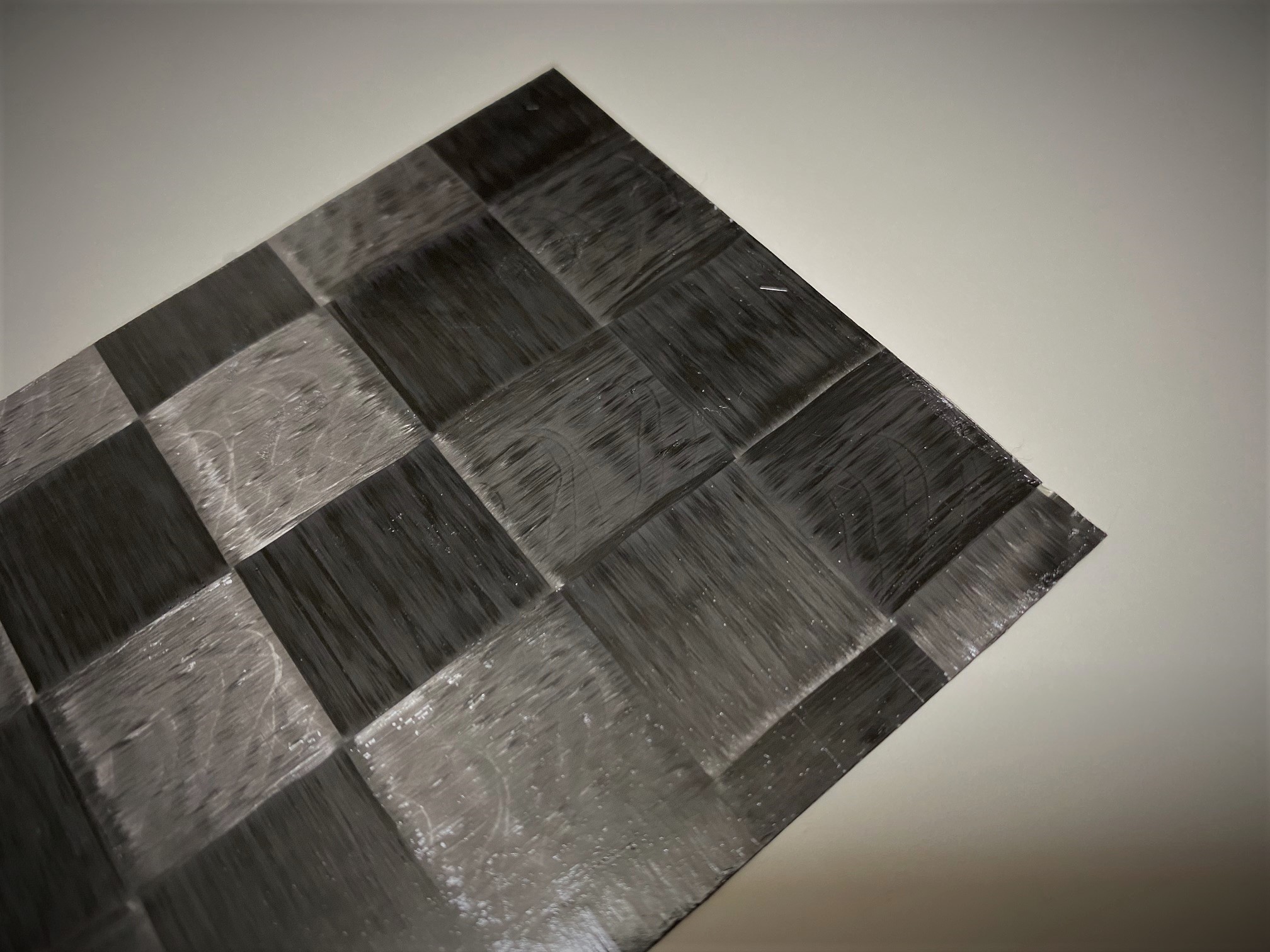
In the photo you can see that, compared with ordinary twill weave, the weave is larger and flatter and the fibers stay closer to straight. Because each ply is thinner, thin, lightweight laminate designs are possible. Its fine, beautiful fiber grain also makes it a favorite for cosmetic surfaces. However, its material cost is higher than ordinary woven cloth.
3. UD (Uni-Directional)
A prepreg with all fibers aligned in one direction. Because there is no crimp as in woven fabric, it is the type with the highest tensile strength and stiffness in the fiber direction. In structural design, fibers can be placed precisely in the load direction, maximizing performance per unit weight.
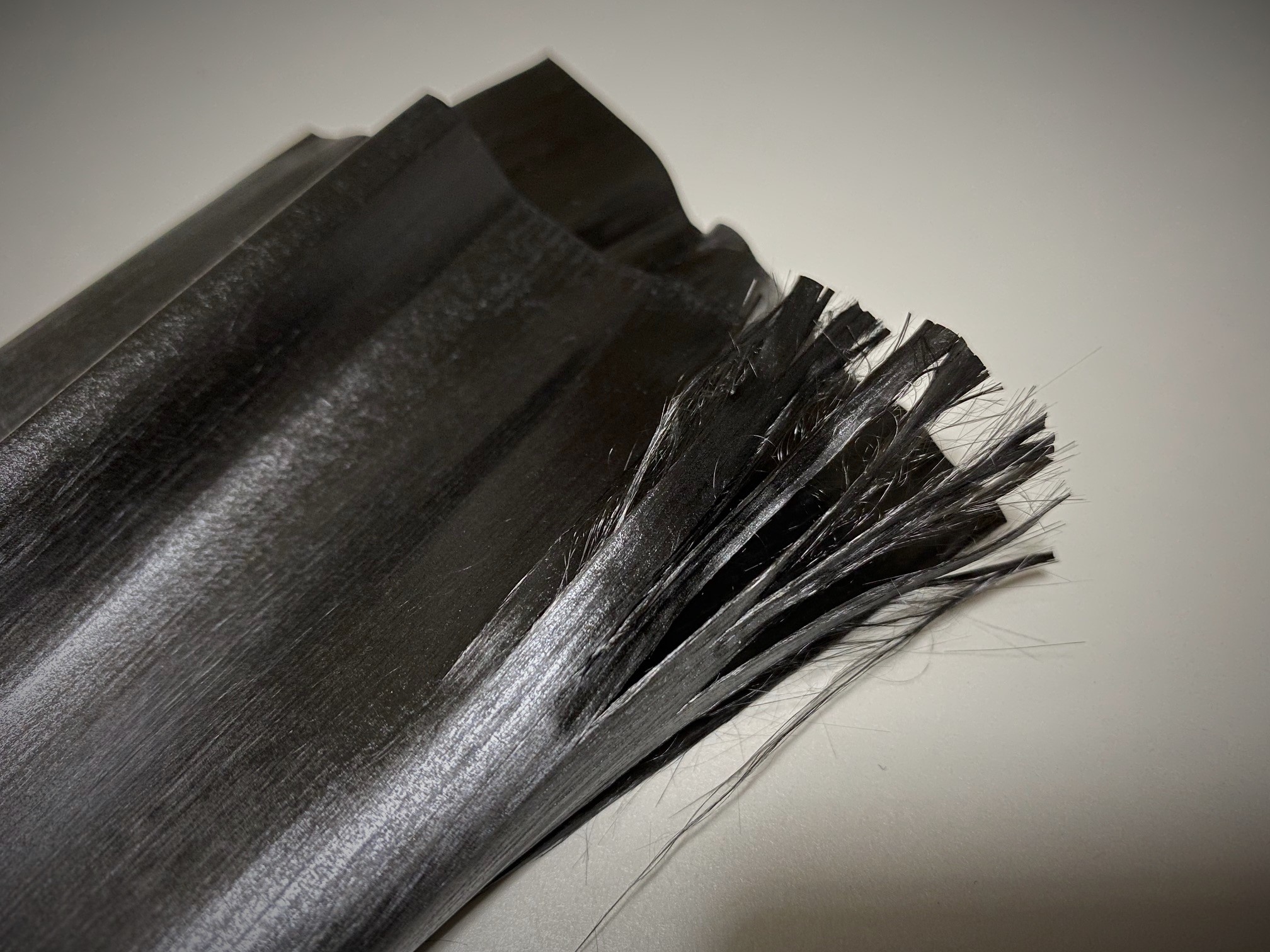
The photo above spreads out the fibers of a UD material to make the true nature of carbon prepreg visually clear. At a glance it looks like a single black sheet, but in reality it is a structure of tens of thousands of ultra-fine carbon fibers, just 5–7 μm (micrometers) in diameter, bundled together and set in resin. Being this “assembly of fibers” is an important point for understanding the properties of CFRP.
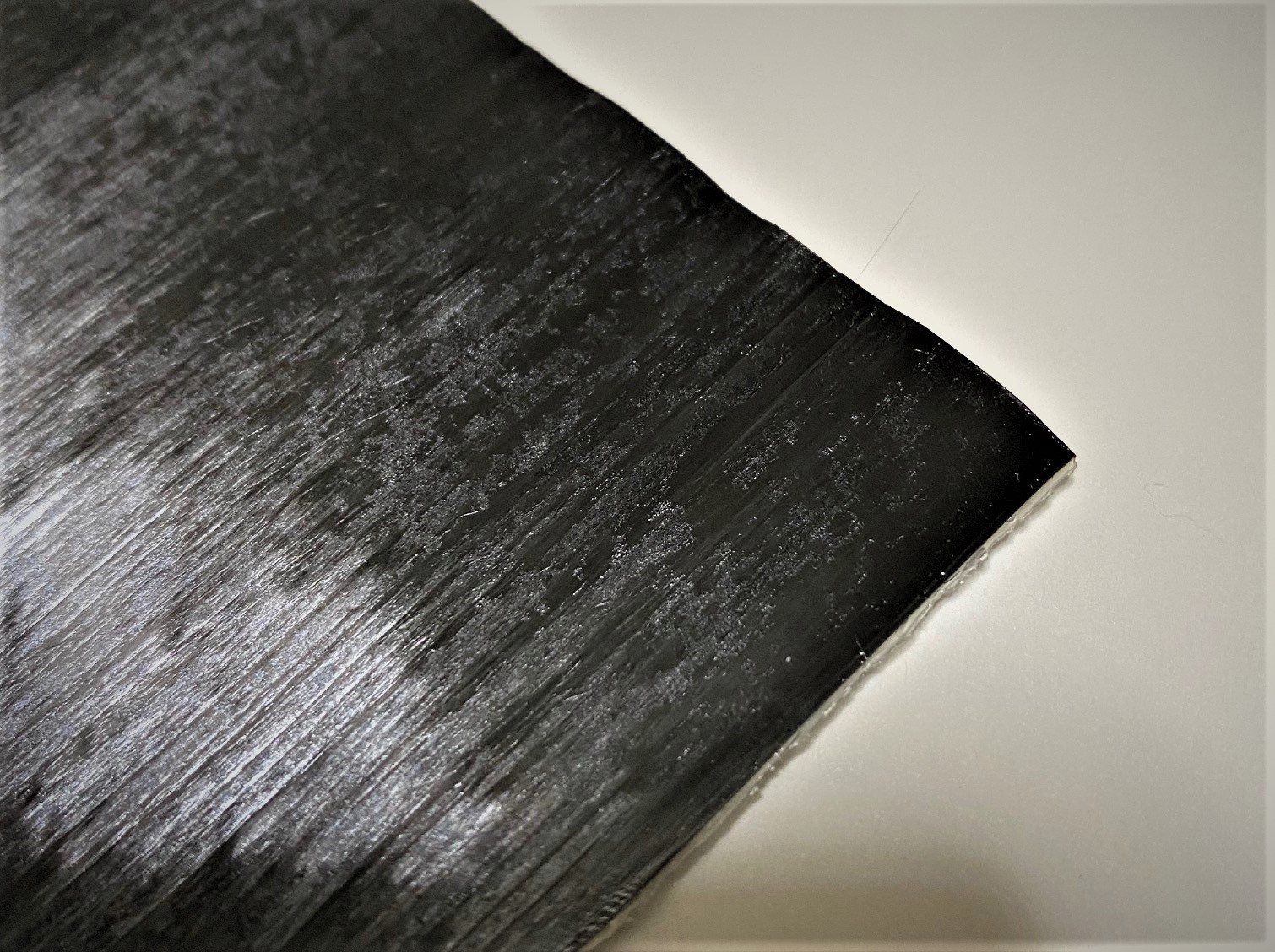
On the flip side, in the direction perpendicular to the fibers there is only the strength of the resin, so it is always laid up at multiple angles (0°/±45°/90°, etc.). Also, because there is no mutual constraint between fibers as in woven fabric, it frays easily when cut, and its conformity to complex shapes is inferior to woven material.
For motorsport monocoques and structural members, it is common to precisely design the layup angles and ply counts of UD prepreg based on load analysis.
4. Aramid (Kevlar) cloth
A prepreg using aramid fiber (a representative brand name: Kevlar®) rather than carbon fiber. Characterized by vivid yellow fibers, it has properties different from carbon fiber.
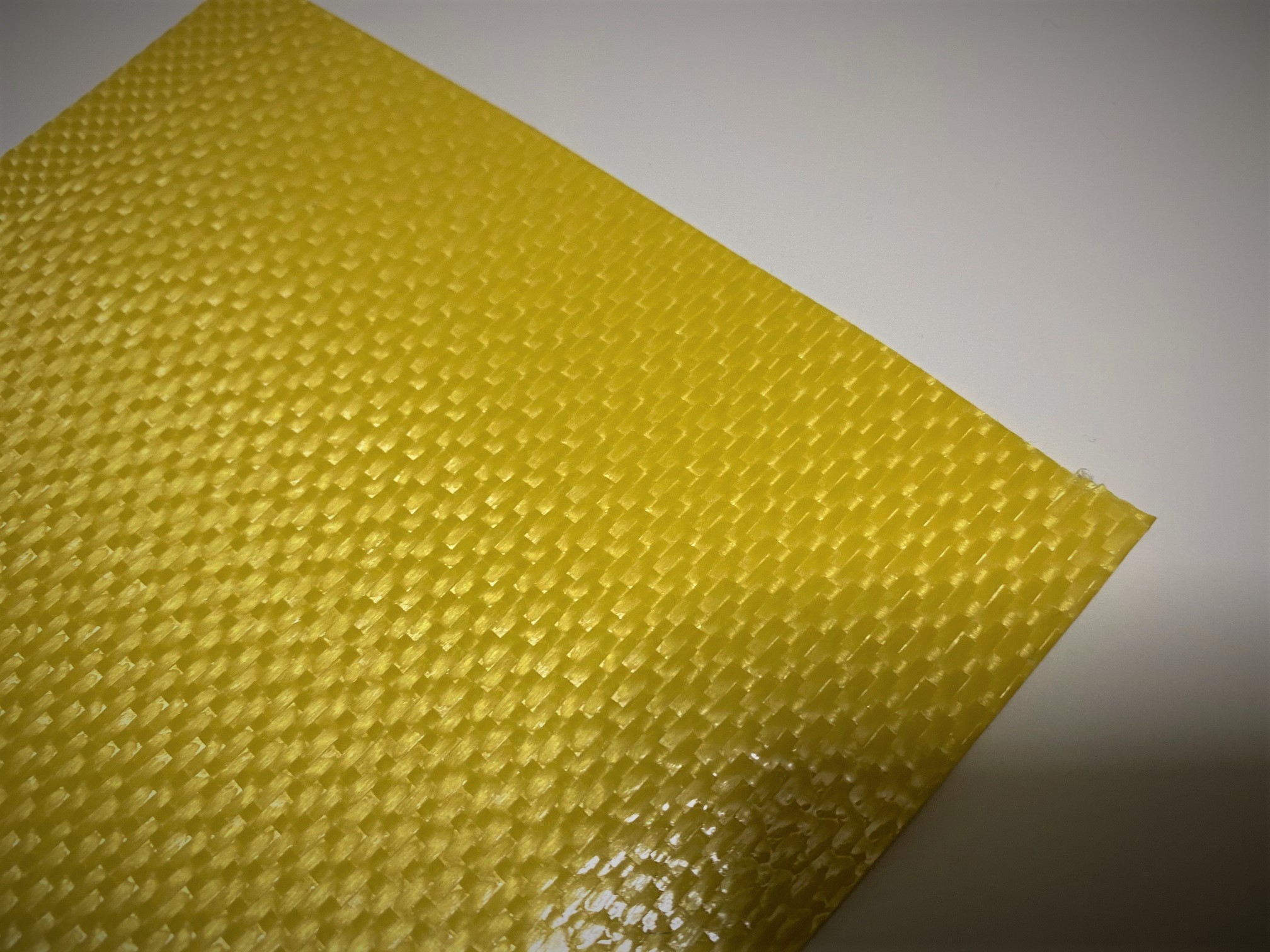
Its greatest advantage is impact resistance. Whereas carbon breaks in a brittle manner under impact, aramid absorbs energy as its fibers stretch, so it has the property of not scattering fragments easily. In some motorsport categories, inserting an aramid layer on the inside of the monocoque for driver protection is mandated by regulation.
Its weaknesses include lower compressive strength than carbon, a tendency to absorb moisture, and difficulty in machining (the fibers fuzz easily). For these reasons, it is often used in hybrid laminates with carbon.
Comparison of prepregs
| Type | Tensile strength | Formability | Characteristics |
|---|---|---|---|
| Woven | Medium | Good | Well-balanced and easy to handle. Max strength lower than UD due to crimp |
| Spread tow fabric | Medium–high | Good | Suits thin, lightweight designs; beautiful appearance. High cost |
| UD (unidirectional) | High (fiber direction) | Somewhat difficult | Top performance in the fiber direction. Weak perpendicular; multi-angle layup essential |
| Aramid | Medium | Somewhat difficult | Excellent impact resistance; prevents fragment scatter. Lower compressive strength |
Summary
CFRP performance is not determined by carbon fiber alone. The type of prepreg (woven, spread tow, UD, aramid), the choice of matrix resin, and the combination of layup design and molding process greatly change the strength, stiffness and impact resistance of the final product.
Extracting maximum performance in motorsport demands the design capability to combine these materials appropriately for each load case.
← Back to blog list